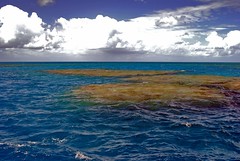
 Image by Michael McDonough via FlickrDoes Coral Have a Sixth Sense?
What do you believe?
Me, I have total faith in the sixth sense of all living creatures on the planet.
If this didn't exist then we just wouldn't of evolved like we have!
Read the article below and make a decision for yourself!
Coral Bleaching (Great Barrier Reef Marine Park Authority)
Corals live in a partnership with single-celled algae known as zooxanthellae. Coral bleaching occurs when this relationship breaks down under stressful conditions - such as higher-than-normal sea temperatures - and the coral host expels its zooxanthe...
Corals can sense what's coming
The ARC Centre of Excellence for Coral Reef StudiesMonday, 21 November 2011
narvikk_-_corals
Corals respond to heat stresses by killing off some of the cells, while strengthening others.
Image: narvikk/iStockphoto
Australian scientists have thrown new light on the mechanism behind the mass death of corals worldwide as the Earth’s climate warms.
Coral bleaching, one of the most devastating events affecting coral reefs around the planet, is triggered by rising water temperatures. It occurs when the corals and their symbiotic algae become heat-stressed, and the algae which feed the corals either die or are expelled by the coral.
 Image via Wikipedia
There have been seven major bleaching events globally in the past 30 years, the most recent being in 2010 across the Indian Ocean and Coral Triangle. Australia’s Great Barrier Reef has suffered eight events since 1980, the worst being in 2002 when 55% of the total reef area was affected. The frequency of these events appears to be increasing.
Now a team of scientists from the ARC Centre of Excellence for Coral Reef Studies and James Cook University has shown that a complex cascade of molecular signals leading up to the self-inflicted death of corals and their symbiotic algae is triggered as sea water begins to warm.
Working with Acropora corals from the reef at Heron Island, the researchers found the cascade begins at ocean temperatures as much as 3 degrees lower than those normally associated with coral bleaching.
And the process culminates in ‘apoptosis’ or programmed cell-death – a situation in which living organisms (including corals and humans) deliberately destroy their weakened or infected body cells, effectively a form of ‘cell suicide’ or amputation designed to protect the organism as a whole.
 Image via Wikipedia
“Our results suggest that the control of apoptosis is highly complex in the coral-algae symbiosis and that apoptotic cell death cascades potentially play key roles in tipping the cellular life or death balance during environmental stress prior to the onset of coral bleaching,” explains lead author Dr Tracy Ainsworth.
“It is also clear that this chain reaction responds significantly to subtle, daily changes in the environment and to sea temperatures which were generally thought till now to have little impact on the function of coral and its symbiotic algae.”
Paradoxically, the team’s research identified molecular signals both promoting and discouraging programmed cell-death in the corals.
This has led them to a theory that corals respond to the stresses caused by warming sea water by killing off some of the cells, while strengthening others in order to stage a possible recovery after the hot water has moved off the reef and conditions have returned to normal.
“This would explain why some corals are able to recover quite quickly from a bleaching event, if it has not gone too far.
“It is far too early to speculate, but understanding the recovery process for any living organism is always a big help, as human medicine has constantly demonstrated, Dr Ainsworth says.
“The next step in our research will be to see how we can use this new insight into the processes of coral bleaching to understand their recovery mechanisms. We also need to know more about how this process works at lower temperatures, or under varying temperatures.
“That in turn will lead us to explore ways that coral reef managers and users can perhaps minimise other stresses on the reef in order to give it the best possible chance of recovery from bleaching.”
However the team cautions that “further study of the tissue function and cellular differentiation and recovery processes in coral is needed before this complicated cell death system can be fully understood”.
 Image via Wikipedia
The team’s paper "Defining the tipping point. A complex cellular life/death balance in corals in response to stress" by Ainsworth TD, Wasmund, K, Ukani L, Seneca F, Yellowlees D, Miller D, and Leggat W is published in the latest issue of Scientific Reports published by Nature.
View the original article here
There you have it!
It's all quite scientific isn't it?
But, hay, it could be great news for our Corals, maybe they are not so doomed after all.
It's nice to see a positive outlook for a change!
But, I do beg all of you please to consider ways to keep limiting your impact on this wonderful planet so other can benefit from what we have in the future!


 The Great Barrier Reef Age – Yes, this reef is steeped with mystery, but science is slowly unwrapping and solving some puzzles. Scientist are digging deep into the reef and discovering some of the oldest known coral reef that has existed on this planet.
 Fish in The Great Barrier Reef - There are over 1500 species of fish that live on the reef that resides off the Queensland Aussie coast and virtually all of them depend on this coral reefs health for their survival. Actually one of these fish can live to more than 50 years of age. Find out its name and more here!
  The Great Barrier Reef Info for kids - Yes coral reef can be just like a wonderland to children and there is also lots that they can learn along the way, while having a great deal fun, especially if your kid loves nature and the great outdoors. Maybe they are an indoors computer kid? But that could easily change with an awesome holiday? To find out more follow the link to the resource page The
  Great Barrier Reef food web - Yes, everything eats everything. Sharks here on the reef would be at the top of the food chain, but when you take a closer look at what humans do to sharks? Mmmm, this really is interesting.
  Information about the Great Barrier Reef- Would you like to know more about the corals and marine life that live and breath the Great Barrier Reef?Follow the link below to get a greater understanding!
 Great Barrier Reef History - There is more to history on this famous reef than just its age! What about shipwrecks? Captain Cook and his views on the reef? And also evolution! Find out more about Great Barrier Reef history here.
  Great Barrier Reef Map - Are you looking to find your way around the reef, surrounding Islands and Australian north east mainland? Follow the link provided here to download the map!


