Showing posts with label James Cook University. Show all posts

Monday, November 21, 2011

Does Coral Have a Sixth Sense?

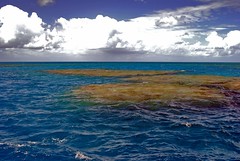
A section of the Great Barrier Reef about 40 m...Image by Michael McDonough via FlickrDoes Coral Have a Sixth Sense?
What do you believe?
Me, I have total faith in the sixth sense of all living creatures on the planet.
If this didn't exist then we just wouldn't of evolved like we have!
Read the article below and make a decision for yourself!
Coral Bleaching (Great Barrier Reef Marine Park Authority)
Corals live in a partnership with single-celled algae known as zooxanthellae. Coral bleaching occurs when this relationship breaks down under stressful conditions - such as higher-than-normal sea temperatures - and the coral host expels its zooxanthe...


Corals can sense what's coming

The ARC Centre of Excellence for Coral Reef Studies
Monday, 21 November 2011
narvikk_-_corals
Corals respond to heat stresses by killing off some of the cells, while strengthening others.
Image: narvikk/iStockphoto

Australian scientists have thrown new light on the mechanism behind the mass death of corals worldwide as the Earth’s climate warms.

Coral bleaching, one of the most devastating events affecting coral reefs around the planet, is triggered by rising water temperatures. It occurs when the corals and their symbiotic algae become heat-stressed, and the algae which feed the corals either die or are expelled by the coral.

 Table coral of genus Acropora (Acroporidae) at...Image via Wikipedia

There have been seven major bleaching events globally in the past 30 years, the most recent being in 2010 across the Indian Ocean and Coral Triangle. Australia’s Great Barrier Reef has suffered eight events since 1980, the worst being in 2002 when 55% of the total reef area was affected. The frequency of these events appears to be increasing.

Now a team of scientists from the ARC Centre of Excellence for Coral Reef Studies and James Cook University has shown that a complex cascade of molecular signals leading up to the self-inflicted death of corals and their symbiotic algae is triggered as sea water begins to warm.

Working with Acropora corals from the reef at Heron Island, the researchers found the cascade begins at ocean temperatures as much as 3 degrees lower than those normally associated with coral bleaching.

And the process culminates in ‘apoptosis’ or programmed cell-death – a situation in which living organisms (including corals and humans) deliberately destroy their weakened or infected body cells, effectively a form of ‘cell suicide’ or amputation designed to protect the organism as a whole.

 A Blue Starfish (Linckia laevigata) resting on...Image via Wikipedia

“Our results suggest that the control of apoptosis is highly complex in the coral-algae symbiosis and that apoptotic cell death cascades potentially play key roles in tipping the cellular life or death balance during environmental stress prior to the onset of coral bleaching,” explains lead author Dr Tracy Ainsworth.

“It is also clear that this chain reaction responds significantly to subtle, daily changes in the environment and to sea temperatures which were generally thought till now to have little impact on the function of coral and its symbiotic algae.”

Paradoxically, the team’s research identified molecular signals both promoting and discouraging programmed cell-death in the corals.

This has led them to a theory that corals respond to the stresses caused by warming sea water by killing off some of the cells, while strengthening others in order to stage a possible recovery after the hot water has moved off the reef and conditions have returned to normal.

“This would explain why some corals are able to recover quite quickly from a bleaching event, if it has not gone too far.

“It is far too early to speculate, but understanding the recovery process for any living organism is always a big help, as human medicine has constantly demonstrated, Dr Ainsworth says.

“The next step in our research will be to see how we can use this new insight into the processes of coral bleaching to understand their recovery mechanisms. We also need to know more about how this process works at lower temperatures, or under varying temperatures.

“That in turn will lead us to explore ways that coral reef managers and users can perhaps minimise other stresses on the reef in order to give it the best possible chance of recovery from bleaching.”

However the team cautions that “further study of the tissue function and cellular differentiation and recovery processes in coral is needed before this complicated cell death system can be fully understood”.

 A variety of corals form an outcrop on Flynn R...Image via Wikipedia

The team’s paper "Defining the tipping point. A complex cellular life/death balance in corals in response to stress" by Ainsworth TD, Wasmund, K, Ukani L, Seneca F, Yellowlees D, Miller D, and Leggat W is published in the latest issue of Scientific Reports published by Nature.
View the original article here

There you have it!
It's all quite scientific isn't it?
But, hay, it could be great news for our Corals, maybe they are not so doomed after all.
It's nice to see a positive outlook for a change!
But, I do beg all of you please to consider ways to keep limiting your impact on this wonderful planet so other can benefit from what we have in the future!

Enhanced by Zemanta

Thursday, October 27, 2011

Turtle Of The Great Barrier Reef Catching Herpes "What the"?

The green turtle is common in Watamu Marine ParkImage via WikipediaTurtle Of The Great Barrier Reef Catching Herpes?
Far out it sounds hard to believe, but apparently these guys are getting sick!
scroll down to watch the video and view the article below to find out more!
Swimming with Sea Turtles - Great Barrier Reef
This green sea turtle kept coming back for another back-scratch. It "wiggled like a cat" when we scratched its shell. He was fit, healthy and very quick when he wanted to be. After about 20 minutes we had to swim away from him.


Herpes like virus sickening sea turtles in Australia Article

A herpes-like virus has sickened sea turtles on Australia's Great Barrier Reef and marine researchers are still at a loss as to why the turtles have become infected with the virus, known as fibro-papilloma. In an effort to determine why the virus has attacked the sea turtles, of which six species call the Great Barrier Reef home, researchers have started tagging healthy turtles off the north Queensland coast, according to a report by the Australian Broadcasting Corp. The tags will monitor the migration of the turtles and the researchers hope that this will help them to determine where the disease is coming from.

In related news, World Wildlife Fund Australia has partnered with James Cook University to help the Great Barrier Reef marine turtles, which have endured a variety of maladies, both natural and man made.
"Sadly extreme weather events earlier this year in Queensland have taken a serious toll on green turtles with the loss of food sources in many areas adding to existing threats from net entanglement and disease," WWF-Australia CEO Dermot O’Gorman said in a prepared statement.
"This has inspired us to seek new ways of working with leading science and turtle health agencies like James Cook University so we can ensure the Great Barrier Reef remains one of the world’s best sanctuaries for green turtles."

The partnership will enable both entities to care for sick and injured turtles in the region, perform research on turtle health and disease, and to push for the establishment of areas of protection for the turtles. The partnership has a heavy workload ahead, as approximately 1000 turtles were found stranded on the coast, most dead, between January and September of this year. Last year, there were 538 strandings/deaths during the same period. Those that were found alive were so sick that emergency care was required.
View original article by the reptile channel here

As you can see from the story above this is quite an issue!
I really hope the scientist can find an answer or nature sorts itself out!
I really love Turtles as you may of seen in previous posts!


Enhanced by Zemanta

Friday, October 21, 2011

Great Barrier Reef Marine Turtles Can We Help

Green TurtleImage by richard ling via FlickrThe Great Barrier Reef Marine Turtles Can We Help?
It seems that we can!
You see these lovely creatures need our help and are dieing for some real crappy reasons!
You see turtles just love to eat jelly fish!
Now they see rubbish as food such as plastic bags and cigarette butts and these kill our lovely turtles.
The plastic bags they think are jelly fish and same with the cigarette butts.
It only takes about 4 cigarette butts to kill a turtle and yes, only one plastic bag!
Watch the video below and then scroll down to see the article I have provided!

Snorkeling with Turtle Eating Jellyfish Great Barrier Reef.m4v
www.facebook.com/snorkelling One of the friendly juvenile Green Turtles in the famous Turtle Bay is feeding on Moon Jellyfish. Webelieve the best snorkeling in the world is a coral reef adventure on a Great Barrier Reef snorkeling trip with Wavelengt...

The Curious Turtle Snorkeling Great Barrier Reef
www.facebook.com/snorkelling Despite constant trespassing and harassment of turtles by people in our famous Turtle Bay site, there are still 3 individual turtles who are still friendly towards snorkellers. Here, Big Girl takes an interest in the came...


The health and conservation of the Great Barrier Reef’s marine turtles is the focus of a new partnership launched in Townsville today between James Cook University and WWF, the global conservation organisation.

The partnership comes at a time when turtles on the Great Barrier Reef are facing continued threats from loss of food, water pollution, disease, entanglement in fishing nets and coastal development.

“Sadly extreme weather events earlier this year in Queensland have taken a serious toll on green turtles with the loss of food sources in many areas adding to existing threats from net entanglement and disease,” said WWF-Australia CEO Dermot O’Gorman.

“This has inspired us to seek new ways of working with leading science and turtle health agencies like James Cook University so we can ensure the Great Barrier Reef remains one of the world’s best sanctuaries for green turtles.”


The partnership will see James Cook University and WWF-Australia working together to provide care for sick and injured turtles, conduct vital research into turtle disease and health, and promote the establishment of protected areas where turtles can be safe from fishing nets and coastal development.


Dr Ellen Ariel, Senior Lecturer at JCU's School of Veterinary and Biomedical Sciences, said the main thrust of the university’s involvement would be research into the plight of the turtles and how best to help, treat, and protect them and their habitats – now and into the future.

“The university has a world-wide reputation in the area of marine sciences,” she said, “and in situations such as exist at present we can access and initiate research across a number of faculties and disciplines.”

Many inshore sea grass meadows – an important source of food for green turtles – were smothered with sediment and pollution after widespread flooding earlier this year. The subsequent impact of Cyclone Yasi added to the problem and removed many of the remaining sea grasses.

Between January and mid-September this year, there have been nearly 1000 turtles found stranded, most of them dead, compared with 538 for the same period last year. The few turtles that are found alive are often emaciated and require emergency care to bring them back to health.

Dr Ariel said that Reef HQ was doing a great job in looking after the distressed turtles, but extra facilities and resources were needed in order to support their efforts.

“With the help of WWF we will be in a position to assist with the overflow of starving turtles – particularly in the present situation where the numbers are overwhelmingly high,” she said.

WWF-Australia contact:

Charlie Stevens, WWF Media Manager - Queensland, 0424 649 689.

Support WWF's efforts to protect our marine turtles
View Original article here!

I hope you enjoyed my video blog post "Great Barrier Reef Marine Turtles Can We Help"? Please share this article with other within your Facebook friends and Twitter feed to get the word out there!

Also if you are a smoker please consider the turtle and the environment and bin those butts!
Have a great day
Marty


Enhanced by Zemanta